A morning ritual for couples that survives a weekday
Short answer
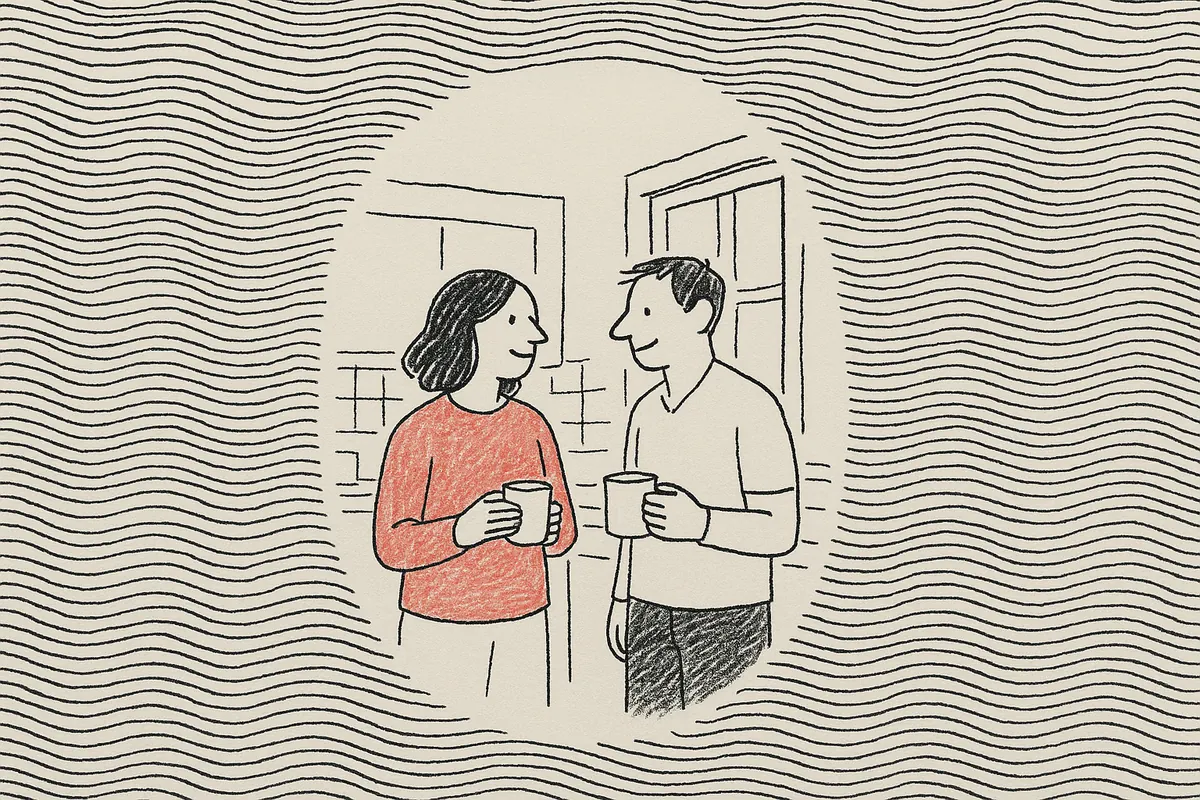
Attach it to something you already do, and make that thing deliberate for ninety seconds. While the kettle boils, before either of you reaches for a phone, stand still and face each other with one hand on the other's back. A morning ritual for couples works when it costs no extra time, only attention.
One to try tonight
The Inner Smile is a free guided practice from the library. The player keeps the time and gives you one phase at a time, so you can practise instead of reading. No account needed.
Why most morning routines for couples fail by Thursday
The advice usually describes a morning nobody has: awake before the alarm, coffee outside, twenty unhurried minutes before the day starts asking for anything. It reads beautifully on a Sunday and it is unusable on a Tuesday, and a practice you cannot do on a Tuesday is not a practice.
The failure is not willpower, it is arithmetic. Anything that asks for time you do not have gets dropped the first morning that runs late, and the first morning that runs late is usually the third or fourth one. What survives is what needs no new time at all.
So the design constraint is an unusual one, and it is worth saying plainly: the ritual has to fit inside a morning you are already having. Not a better morning. This one.
The ninety second version
Pick a moment that already happens every morning without anyone deciding it. The kettle, the shower running, the minute after the alarm before either of you moves. Then give that moment four things:
- An anchor. The same moment every morning, chosen once. It is the kettle or it is the alarm, and you do not renegotiate it at six in the morning.
- A stop. Both of you stand still, or stay lying down, and stop doing the thing for the length of it. Continuing to move is what keeps a morning feeling like it is already running away.
- One point of contact. A hand between the shoulder blades, foreheads touching, palms flat against each other. One is enough, and the same one every day is better than a new idea every day.
- An ending you both hear. A breath out, a word, a squeeze of the hand. Without one the ritual does not end, it gets interrupted by the day, and it starts to feel like something taken from you rather than something you did.
That is the whole thing. Ninety seconds is not a compromise version of a longer practice. It is the length that actually gets done.
What to do when your mornings do not match
Plenty of couples do not wake up together, and the ones who do often wake up in different states. One is talking by the second minute, the other needs forty minutes and no questions. Running a shared practice across that gap is how a good idea turns into a small daily resentment.
Two fixes, and either works. Move the anchor to the first moment you are both awake and in the same room, even if that is twenty minutes after one of you got up. Or keep the mornings separate: the early one has a short practice alone, the later one has theirs, and the shared minute happens at the door before someone leaves.
If one of you is gone before the other wakes, set the beginning of the day the night before. A ritual that has to happen at seven is a schedule, and what you are actually protecting is the start of the day, which can be agreed on the evening before it arrives.
The longer version, for a morning with no alarm
When a morning has nothing pulling at it, the same structure stretches without changing shape. Twenty minutes, the same anchor, the same single point of contact, and the only difference is that you stay longer than the moment asks for.
Stay where you already are rather than moving somewhere special. A morning practice that needs setting up becomes a project, and projects get scheduled and then postponed. Sitting up facing each other, or lying still with one hand on the other's chest, is the whole setting.
Sensuality is welcome here and it is not the assignment. Saying out loud that nothing has to follow is what lets both of you settle into the twenty minutes instead of reading them for signals.
Keeping it, once it exists
Do not add to it for a month. The instinct after a good week is to make it longer or better, and that is reliably how it dies: the improved version needs a morning the ordinary version did not.
Expect to miss mornings. A practice with a perfect record is one you have been doing for four days. Missing three in a row and starting again on the fourth is the actual skill, and starting again is much easier when the thing you are returning to is ninety seconds long.
Common questions
What is a good morning ritual for couples?
One that attaches to something you already do every morning and asks for less than two minutes: a still moment while the kettle boils, one point of contact, and a clear ending. The particular gesture matters far less than both of you knowing when it starts and when it is over.
How long should a morning ritual take?
Ninety seconds is enough on a weekday, and being short is what makes it repeatable. Save the twenty minute version for mornings with no alarm. A practice measured in seconds and done daily does more than one measured in minutes and done rarely.
What if we wake up at different times?
Move the anchor to the first moment you are both awake in the same room, even if that is half an hour after one of you got up. If one of you leaves before the other wakes, agree on the start of the day the night before instead, and let the doorway be the shared moment.
What if one of us hates mornings?
Then the practice has to ask nothing of them: no talking, no eye contact, no decisions. A hand on the back for one breath asks nothing of someone who is not awake yet, which is exactly why it works better than a conversation.