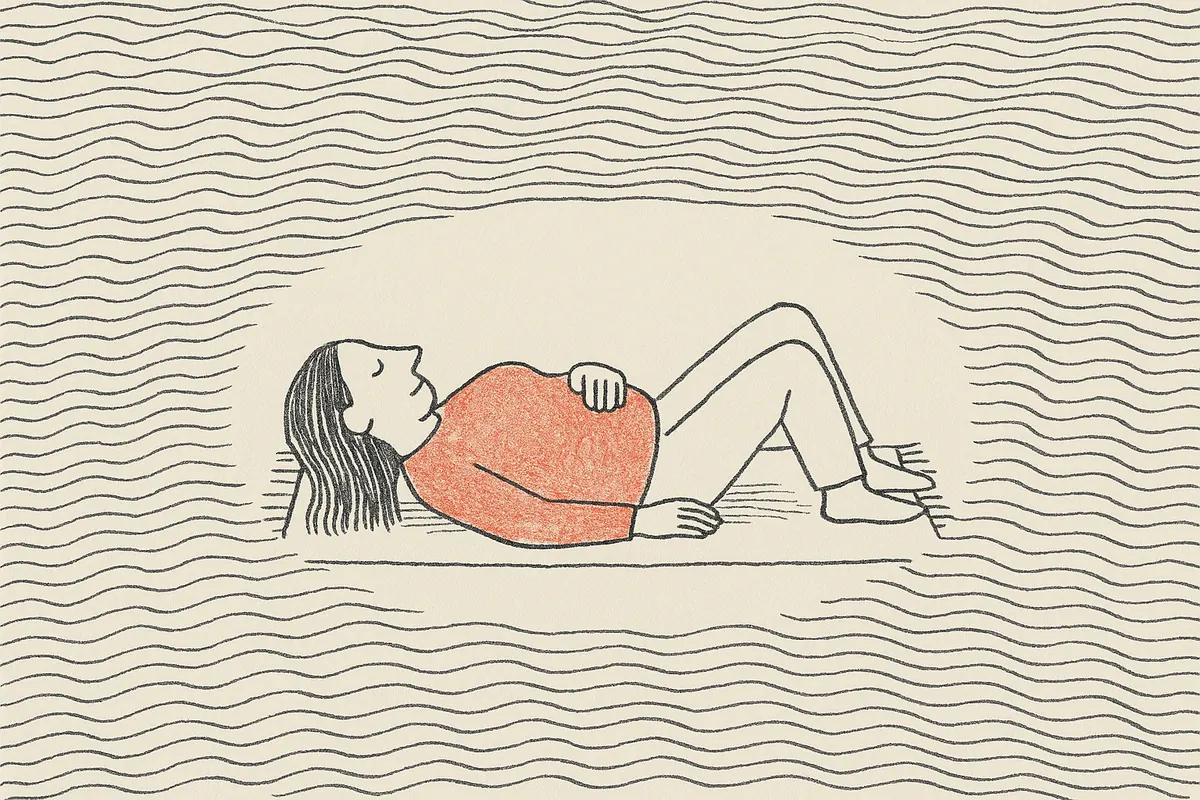
A solo intimacy practice for beginners
Short answer
A solo intimacy practice is deliberate, unhurried time in your own body: fifteen minutes, alone, phone elsewhere, with slow attention on breath and sensation rather than on any goal. Begin with a warm shower taken slowly, five minutes of stillness with a hand on your chest, and five minutes of easy, curious touch on the arms, neck, and face. Nothing has to happen. Noticing is the practice.
One to try tonight
The Inner Smile is a free guided practice from the library. The player keeps the time and gives you one phase at a time, so you can practise instead of reading. No account needed.
What this is, and what it is not
A solo practice is time set aside to be in your body on purpose: feeling instead of scanning, attending instead of managing. It is not the same thing as habitually getting something over with, and it is not a self improvement program with sensation as homework. The point is not to achieve an experience. It is to be present for one.
People come to this for different reasons: to feel at home in a body that has mostly been a vehicle, to slow down a pattern that has gone quick and automatic, to rebuild trust with themselves after a stretch of numbness or absence, or simply out of curiosity. All of these are enough reason. None requires explanation to anyone.
A fifteen minute beginning
This is a complete first practice. Repeat it as is for a couple of weeks before adding anything.
- Make the container: door closed, phone in another room, light low, somewhere warm. Decide the fifteen minutes in advance, and let them be unowed to anyone.
- Start with a shower or a basin of warm water, taken at half speed. Water is the easiest doorway into the skin: notice temperature, pressure, the places that relax under it.
- Sit or lie down. One hand on your chest, one on your belly. Five slow minutes of just breath, feeling the hands rise, letting the weight of the day drain out of the shoulders.
- Five minutes of slow, curious touch on easy territory: forearms, neck, scalp, face. Vary the pressure and the speed. You are not producing a feeling. You are finding out what is there.
- Close on purpose: both hands still, one full breath, one word for what you noticed. Then get up slowly and let the evening be ordinary again.
If your attention wanders the whole time, that was still the practice. Coming back a hundred times is not failing at presence. It is presence.
Going further, gently
After a few weeks, the practice can widen on its own terms: more of the body, more time, more curiosity, including erotic sensation if and when that is what draws you. The same two principles keep it a practice rather than a shortcut: no goal it has to reach, and no hurry it has to obey. Pleasure explored this way tends to get slower, wider, and more interesting than the quick versions the body already knows.
The library's solo practices are built as guided versions of exactly this arc, from a first settling practice like The Inner Smile, through an erotic practice built on the same two principles like Self-Pleasure as Practice, to slower, deeper work like The Expanding Edge, each with its phases and timing already shaped. Using one is like practicing with a teacher in the room who never watches.
Common questions
Is this just a fancy name for masturbation?
They can overlap, and they are not the same thing. The difference is the stance: a goal and a hurry versus attention and time. A solo practice may include erotic touch or none at all. What defines it is that you are present for it, not what it does or does not lead to.
I feel nothing when I slow down. Is something wrong?
No. A body that has been busy or braced for a long time often goes quiet before it goes vivid. Numbness easing into faint sensation is the usual arc, and it takes repetitions, not effort. If strong feelings of another kind surface and stay heavy, that is worth bringing to someone you trust.
How often should I practice?
Twice a week, fifteen minutes, beats an occasional long session. Regularity is what teaches the body that this time is real. Attach it to an existing edge of the day, after the shower, before bed, so it has somewhere to live.