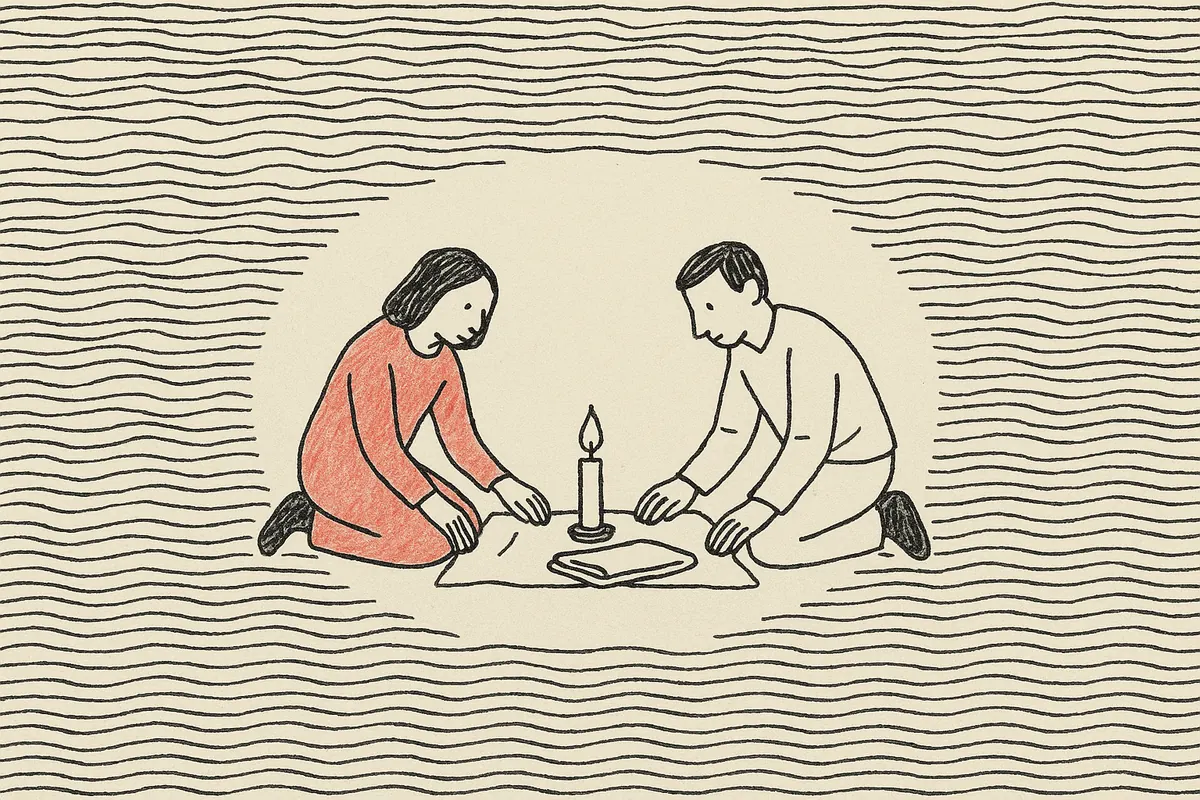
How to create a ritual with your partner
Short answer
Pick one small occasion you already share, give it four things: a fixed time, a clear opening, one repeated action you both know, and a real ending. A ritual is not a habit with candles. It is time the two of you have agreed means something, and the agreement, not the content, is what does the work.
One to try tonight
The Mystery Ritual is a free guided practice from the library. The player keeps the time and gives you one phase at a time, so you can practise instead of reading. No account needed.
What makes something a ritual and not a routine
You already have routines together: the coffee, the commute call, the same side of the bed. A routine is repeated behavior that saves attention. A ritual is repeated behavior that concentrates it. Same materials, opposite direction.
The conversion happens through agreement. When both of you have said, in effect, this ten minutes is ours and it means something, the same cup of tea becomes a different object. That is why copying someone else's beautiful ritual so often falls flat: the form was never the active ingredient. The agreement was.
The four decisions
Build it together, once, in a single ten minute conversation. Four decisions:
- When, exactly. Not often, not more, but a slot: Sunday after dinner, the first ten minutes after the kids are down. Rituals survive by being attached to time that already exists.
- How it opens. One repeatable signal that the ritual has begun: a particular candle, the phones dropped in a bowl, the same two cups. The signal matters because it does the starting for you on the nights you are tired.
- What happens. One thing, not a program: three questions over tea, ten minutes of quiet touch, a short practice from the library, a slow dance to one song in the kitchen. Choose something that needs no willpower on a bad week.
- How it ends. A closing as clear as the opening: the candle out, one sentence of thanks, a kiss with some weight in it. Endings are what make the next beginning feel like something.
Starting without the cringe
The awkwardness of proposing a ritual to your own partner is real and worth naming: it can feel like admitting the relationship needs scaffolding, or like inviting them to a seminar. The clean way through is to propose it as an experiment with a number on it: four weeks, then we decide together whether it stays.
An experiment asks for curiosity instead of belief. Four weeks is long enough for the awkwardness to burn off, which it does, and short enough that saying yes costs little. Most rituals that survive the four weeks stop being an experiment without anyone announcing it.
Let it be theirs too
A ritual designed entirely by one partner stays that partner's project, and projects get audited. Bring the shape, then hand over real decisions: they pick the night, or the music, or the question. Ownership is what turns attendance into participation.
And when it misses a week, and it will, treat that the way you would treat missing anything you both value: no scorekeeping, no meaning making, just the next one. A ritual is not a streak. It is a place that stays where you left it.
Common questions
My partner thinks rituals sound forced or woo. Now what?
Drop the word. Propose the thing itself: ten minutes, Sunday, tea, three questions, four weeks and then we decide. Most resistance is to the label and the earnestness around it, not to ten protected minutes with someone they love.
How long until it stops feeling artificial?
Usually two or three repetitions. The first time is self conscious, the second is familiar, and somewhere around the third or fourth the body starts arriving before the mind does. That shift is what the fixed time and the repeated opening are for.
Can the ritual include sex?
It can, and some of the strongest couple rituals are unhurried physical practices. The one rule that keeps it working: decide what the container is beforehand, so the time is never a bait and switch. A ritual that is secretly a request stops being safe, and safety is what made it work.