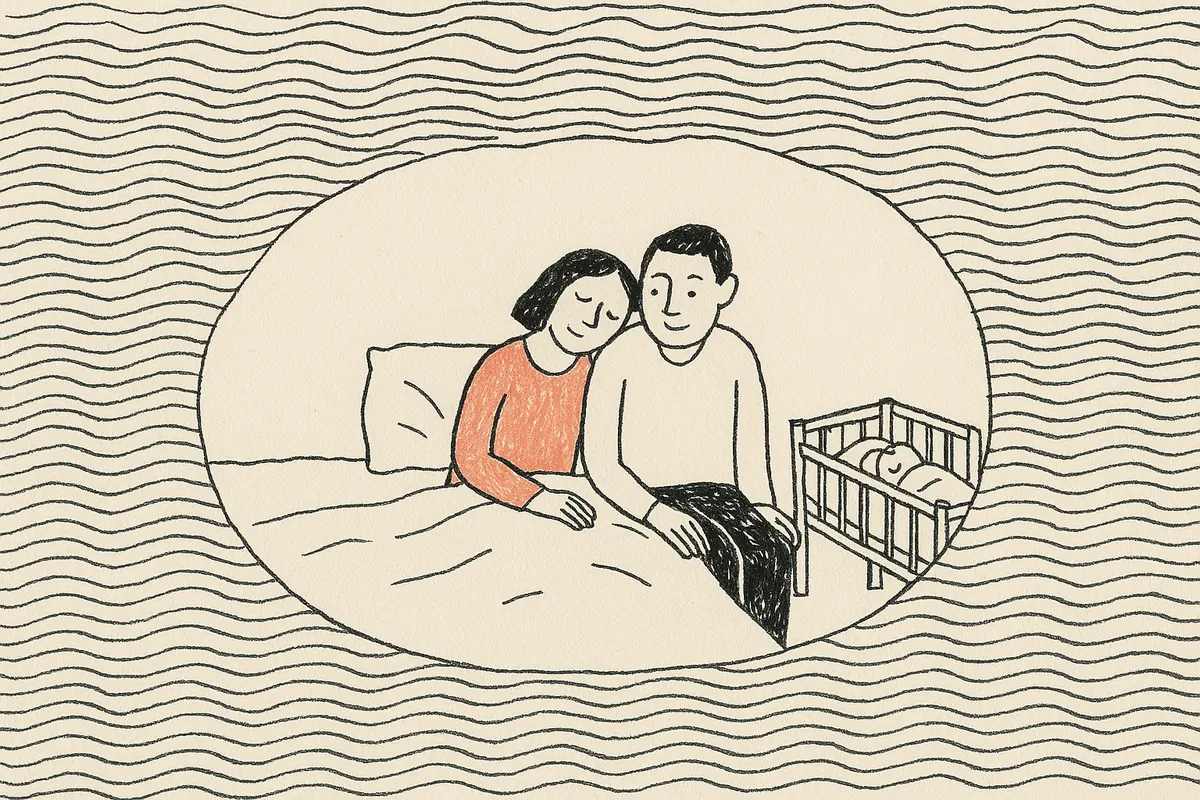
How to reconnect with your partner after having a baby
Short answer
Shrink the unit of connection until it fits the life you actually have. Five minutes of full attention, once a day, beats a date night you are too tired to feel. Keep some touch alive that asks for nothing, name out loud that the distance is circumstance rather than verdict, and let the old rhythm come back in pieces instead of waiting for it whole.
One to try tonight
Eye-Gazing Threshold is a free guided practice from the library. The player keeps the time and gives you one phase at a time, so you can practise instead of reading. No account needed.
What actually happened to the two of you
Almost everything that used to carry your closeness got repurposed. The unhurried evenings, the lazy mornings, the spontaneous touch, the attention you paid each other because there was nowhere else it needed to be: all of it is currently feeding, settling, and keeping a small person alive. The connection did not break. The carriers it traveled on are busy.
It helps to say that sentence to each other, more or less as written. The quiet fear in this season is that the distance means something about the relationship. Naming it as logistics, out loud, takes the menace out of it. What is left is a scheduling problem, and scheduling problems have solutions.
Make the unit smaller
The mistake most couples make is keeping the old unit of connection, the evening out, the long night in, and waiting for enough time and energy to afford it. That wait can last a year. The move that works is the opposite one: shrink the unit until it fits inside the life you have this week.
- Five minutes of real attention once a day. Sitting down together after the baby is asleep, phones elsewhere, one question that is not about the baby or the chores. That is the whole practice.
- One longer piece a week if you can get it: twenty minutes, the door closed, something with a shape, a short practice from the library rather than an open evening neither of you has the energy to fill.
- A one breath ritual at handoffs. When one of you takes the baby from the other, one actual look, one hand on the shoulder or the back of the neck, one breath. It takes three seconds and it is the difference between passing a person and passing a package.
None of this is impressive, which is the point. In this season, reliability is worth more than intensity, and five minutes that happen beat an hour that keeps not happening.
When one of you is touched out
A parent who has carried, fed, and soothed a baby all day can reach the evening with their skin fully spent, wanting nothing so much as to be left alone in their own body. The other parent, often more removed from that all day contact, can arrive at the same evening starving for touch. Neither of you is wrong. You are standing at opposite ends of the same day.
Two things help. The first is separating affection from request: touch that asks for nothing, announced as asking for nothing, stays receivable long after loaded touch has become too expensive. A hand on the back with the words nothing attached to this is a different object from the same hand with a question in it.
The second is letting the spent partner set the terms for a while: where, how long, how much. Being able to say a shoulder is fine and my hands are done for today, and have it simply be true, is what lets touch stay in the relationship at all during this stretch.
About desire, since nobody brings it up on their own
For most couples, desire goes quiet for a while after a baby, and for longer than anyone warns you. Exhaustion, recovery, a body that feels like it belongs to someone else's schedule: it all runs in the opposite direction from wanting. This is ordinary, it is not a verdict, and the worst response to it is pressure, including the quiet pressure of one partner silently keeping count.
What keeps the pilot light on is not effort toward sex. It is the small physical warmth that stays unconditional: the six second kiss at the door, the hand that rests without asking, the ten minutes of sitting close. Desire tends to come back the way appetite does after an illness, in small returns, and it comes back sooner in a body that has stayed gently in contact than in one that has been left alone and then approached with an agenda.
Common questions
How soon should things go back to normal?
There is no schedule, and most couples find the honest answer is slower than they expected and faster once they stopped waiting for the old normal. The aim is not to get back to the couple you were. It is to build the next version in the life you have now.
We only have five minutes a day. Is that even worth it?
Five minutes that actually happen, daily, will do more for the feeling between you than a monthly grand gesture. Attention compounds. The point is not the size of the deposit, it is that the account stays open.
What if we disagree about how much touch is okay right now?
Let the person with less capacity set the floor, and let the touch that happens be genuinely free of expectation. A smaller amount of touch that is safe to receive keeps more connection alive than a larger amount that has to be braced against.
Ready when you are
Eye-Gazing Threshold, timed and guided, whenever you want it.