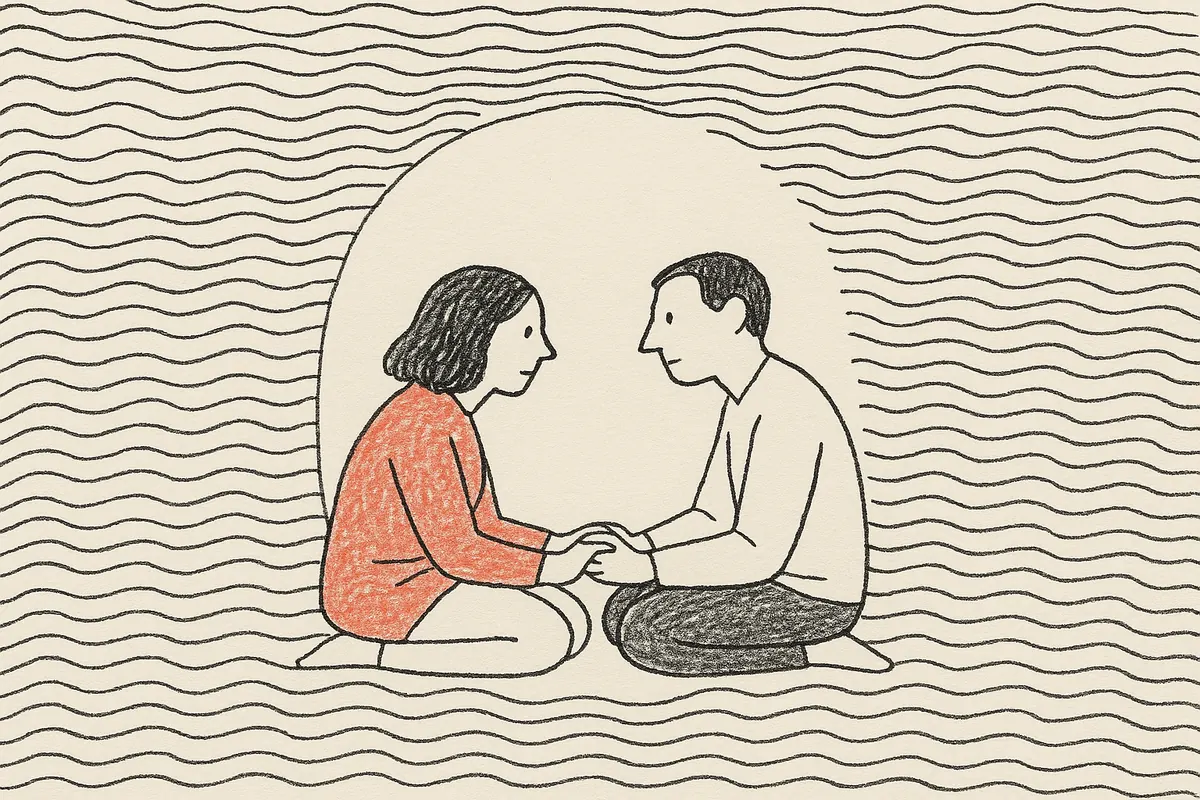
How to feel closer to your partner without talking about it
Short answer
Do something together that has a shape: a fixed length of time, a clear beginning, and one simple thing to pay attention to. Closeness comes back through shared attention more reliably than through explanation. Ten minutes sitting together, breathing, with no agenda and nothing to resolve, will often do more than an hour of talking about the distance.
One to try tonight
Eye-Gazing Threshold is a free guided practice from the library. The player keeps the time and gives you one phase at a time, so you can practise instead of reading. No account needed.
Why talking about it can make the distance louder
A conversation about closeness asks both people to do the hardest possible thing at the least possible moment: describe a feeling neither of you has words for yet, to the one person whose reaction matters most. It is a reasonable thing to want. It is also a lot to ask of a Tuesday evening.
The other problem is that the conversation makes the distance the subject. For the length of it, you are two people studying a gap. That is a strange position to feel close from, and it is why these talks so often end with both people agreeing, sincerely, that things should be different, and nothing changing.
None of this means the conversation is wrong. It means it is often the wrong first move. Something wordless tends to work better as an opening, and it usually makes the conversation easier if you still want it afterward.
What works instead: give the time a shape
The thing that reliably shifts the feeling is shared attention with a container around it. Three parts, and all three matter:
- A fixed length. Decide it in advance and say it out loud. Ten minutes is enough. Knowing when it ends is what lets both of you stop managing it.
- A clear beginning. Put the phones in another room, turn the lights down, sit down at the same moment. The point is a line you both cross on purpose, not a slow drift into being in the same room.
- One thing to attend to. Breath, a hand, the other person's face. One, not several. Attention that has one object is restful. Attention with nothing to land on turns back into thinking.
What you are building is a small, deliberate occasion. Not a discussion, not a date, and not a performance of romance. Just a shape that holds attention for a set amount of time.
A ten minute version to try tonight
If you want something concrete, this is a complete practice. It needs no preparation and no equipment.
- Sit facing each other, close enough that your knees almost touch. Agree out loud that this is ten minutes and that neither of you has to talk.
- For the first two minutes, close your eyes and follow your own breathing. Not deeper, not slower, just noticed. Let the room get quiet around you.
- For the next three minutes, open your eyes and let your gaze rest somewhere easy on your partner: their hands, the side of their face. Not a stare, and not a test. If you laugh, laugh. It passes.
- For the next three minutes, rest one hand somewhere unhurried on them, a shoulder, a forearm, the back of a hand, and leave it there. Feel the weight of your own hand as much as the skin under it.
- For the last two minutes, close your eyes again and notice what is different in your body than it was ten minutes ago. Then say one sentence each, or say nothing, and let it end.
You will probably feel self-conscious the first time. That is not a sign it is going badly. Awkwardness is what paying deliberate attention feels like before it becomes familiar.
If one of you wants to talk and the other does not
This is the common case, and it is worth naming plainly rather than solving cleverly. The person who wants to talk is usually trying to get to the same place the practice goes. The person who does not want to talk is usually not refusing closeness, only the format.
A practice with a fixed end is easier to agree to than an open ended conversation, because ten minutes is a small thing to say yes to. Offer it as an experiment with a time limit rather than as a substitute for the conversation. Often the talk happens anyway, afterward, and goes better.
When to do it
Regularly beats intensely. A short practice on an ordinary Wednesday does more than a long one saved for a night that already carries expectations. Anniversaries and getaways are wonderful and they are also the moments least likely to need help.
If you want it to keep happening, attach it to something that already does: after the kitchen is cleaned up, before either of you opens a laptop again, the first ten minutes after the house goes quiet.
Common questions
What if it just feels awkward?
It usually does at first, for both of you. Awkwardness comes from doing something deliberately that you normally do by accident. It fades somewhere in the second or third try, and it fades faster if you agree in advance that laughing is allowed.
How long should it be?
Ten minutes is enough to feel different and short enough that neither of you has to plan around it. Longer is not better at the start. What matters more than length is that you decided the length in advance.
Is this just avoiding the conversation?
It can be, if it replaces a conversation someone genuinely needs to have. It is not avoidance when it comes first. Shared attention makes the difficult conversation easier to start and easier to hear, which is a different thing from making it unnecessary.
Does this have to lead to sex?
No, and it works better when that is settled out loud beforehand. Saying that nothing is expected removes the low background pressure that stops one or both of you from relaxing. What happens after the ten minutes is a separate decision.
Ready when you are
Eye-Gazing Threshold, timed and guided, whenever you want it.