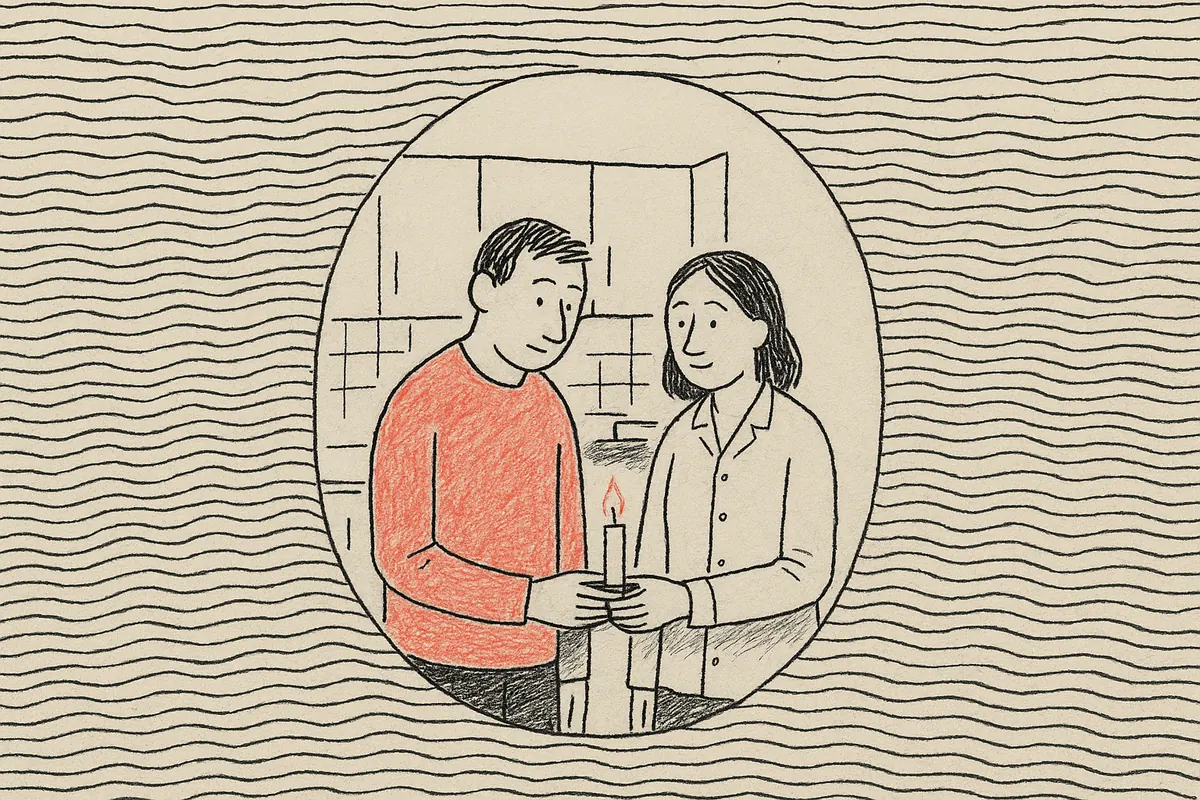
Anniversary ritual ideas for a night at home
Short answer
Skip the reservation and build the evening in three movements: a clear opening that separates the night from the ordinary week, a middle that looks at the year you actually had, and a closing that faces forward. The difference between a nice dinner and a night you both remember is structure, not budget.
One to try tonight
The Mystery Ritual is a free guided practice from the library. The player keeps the time and gives you one phase at a time, so you can practise instead of reading. No account needed.
Why the restaurant so often falls flat
An anniversary dinner out is pleasant, and it is also two people in their usual roles, managing menus and noise, performing the occasion at each other across a table. The date gets marked. The marriage, the actual accumulated year of it, never quite enters the room.
What an anniversary wants is not luxury. It is a container: a stretch of time with a beginning, a middle, and an end, in which the two of you are the only subject. Home is better for this than any restaurant, because at home nobody brings the bill while you are in the middle of a sentence that matters.
The shape that works, at any length
Every version of this evening, short or long, has the same three movements:
- Open deliberately. Change the room: lower light, phones gone, something poured. Mark the start out loud, even with one sentence. The opening is what tells both nervous systems that this is not a regular Tuesday.
- Look back together. The year as it actually was: the best moment, the hardest one, the thing you each watched the other survive. One question at a time, both answering, no fixing.
- Close facing forward. One hope each for the coming year, said plainly, and then a real ending: a toast, a long kiss, the candle blown out. An evening that just trails off into scrolling loses half its weight.
Three versions to choose from
Twenty minutes: the exchange. Light one candle, sit close, and take turns finishing three sentences: this year I loved, this year was hard when, next year I want us to. Blow the candle out together. Small enough for an anniversary that lands on a work night, and more than most couples ever say to each other about a year.
One hour: the meal as ritual. Cook one course together, slowly, then eat it by candlelight with the three movements above woven through: open before the cooking, look back over the food, close after the plates are pushed away. The cooking is not preparation for the ritual. It is the first act of it.
Two hours: the full evening. Begin apart, fifteen minutes each to bathe and dress as if going somewhere, because you are. Meet at the table as guests. Dinner, the looking back, and then a slow unhurried hour with a practice from the library, the kind of close, attentive time the first year of marriage had by default. End with the forward look and a proper toast.
Whichever length you choose, decide it in advance. An evening with agreed edges relaxes in a way an open ended one never does.
The mistake that flattens it
The one reliable way to sink the night is to leave it unplanned on the theory that spontaneity is more romantic. What actually happens is that both of you arrive tired, nobody wants to impose a plan on the other, and the evening dissolves into a nice dinner and a film. Romance on an anniversary is not spontaneity. It is evidence of forethought: the sense, unmistakable in the room, that your person built something for you.
It does not matter which of you builds it, and it works best when the builder rotates year to year. What matters is that one of you does, and that the other arrives willing to be led through it.
Common questions
What if we have kids in the house?
Use the twenty minute version after they are asleep, and treat the closed bedroom door as the boundary. If a full evening matters this year, trade sleepovers with another family. The ritual does not need the whole house. It needs one room nobody will walk into.
Is an at-home anniversary settling for less?
Only if the evening is the same as any other night plus takeout. A built evening, with a shape and an intention, is rarer than any restaurant. Most couples have eaten out hundreds of times. Very few have ever been led through an evening made for them.
What if talking about the hard parts of the year feels risky?
Keep the looking back to one hard thing each, said without blame and received without defense, and agree on that rule beforehand. An anniversary can hold one honest sentence about difficulty. It should not become the venue for the whole negotiation.